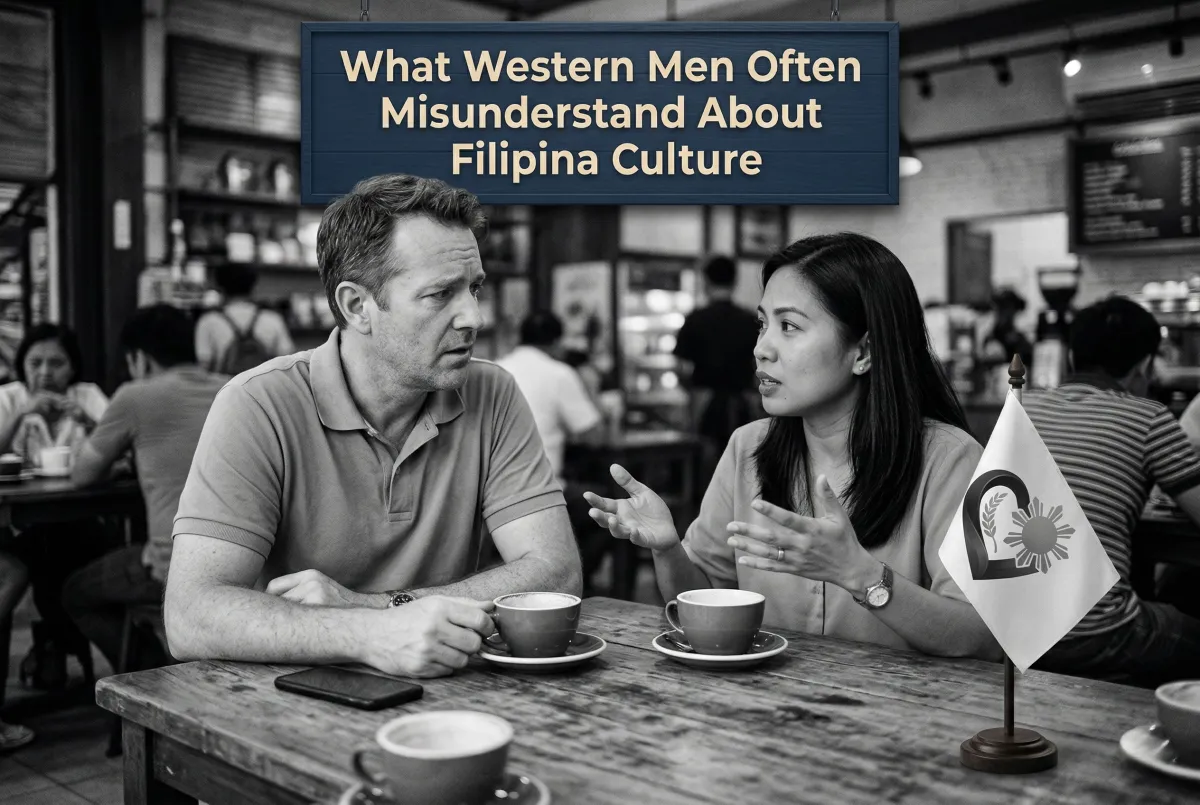
What Western Men Often Misunderstand About Filipina Culture
Looking past stereotypes and learning what actually matters
A lot of Western men come into Filipina dating with the wrong map.
Some arrive with respect and curiosity. Good.
Some arrive with stereotypes, fantasy, and a suitcase full of assumptions. That usually blows up sooner or later.
If you are serious about building something real with a Filipina, you need to understand this: not everything should be judged through an American lens. Filipino culture has its own logic, its own priorities, and its own social codes. If you ignore that, you may misread kindness, family loyalty, caution, modesty, or indirect communication as something they are not.
At Pinoy West, we believe better relationships start with better understanding. Not fantasy. Not ego. Not “I know women already.” Culture changes the context, and context matters.
1. Family is not “background noise”
One of the biggest things Western men misunderstand about Filipina culture is the role of family.
In the Philippines, family is often the foundation of social life, and those ties can extend beyond the nuclear household to grandparents, aunts, uncles, cousins, and even close family friends. That means family is not always a side issue. In many cases, it is central to identity, duty, and decision-making.
An American man may think, “Why does her family have so much input?” A Filipina may think, “Why would you expect family not to matter?” That is not a small misunderstanding. That is a worldview clash.
This does not mean every Filipina wants her family controlling her relationship. It does mean that if you treat family as irrelevant, you may look selfish, immature, or culturally tone-deaf. Respecting the importance of family is often part of respecting her.
2. Kindness is not weakness
Many Filipinas are raised to value respect, tact, humility, and getting along well with others. Filipino communication is often more diplomatic and less blunt than mainstream American communication. People may soften criticism, avoid direct confrontation, or choose words carefully to preserve harmony and avoid embarrassment.
Some Western men mistake that for passivity. Wrong move.
A woman being gentle does not mean she is naive. A woman being polite does not mean she agrees with you. A woman avoiding public conflict does not mean she has no standards. It may simply mean she values dignity, social harmony, and self-control more than dramatic confrontation.
If you come in too sharp, too loud, or too “brutally honest,” you may think you are being real. She may think you are rude, disrespectful, or unstable. That is the kind of mistake that ruins trust before the relationship even gets off the ground.
3. Respect runs deeper than manners
Respect in Filipino culture is not just about saying “please” and “thank you.” It is often tied to age, family position, social role, and the way people carry themselves in relationships. Cultural Atlas notes that respect is a core part of Filipino culture and is often demonstrated through speech and deference to elders or those of higher status.
That matters in dating.
If a Western man speaks carelessly about her parents, dismisses her family obligations, or acts overly casual in moments that call for restraint, he may think he is just being himself. She may see a man with poor upbringing and no cultural sensitivity.
Respect also shows up in how you handle correction, disagreement, patience, and public behavior. In other words, it is not just what you say. It is how you carry yourself. Old-school truth: character talks long before charm finishes introducing itself.
4. Indirect communication does not mean dishonesty
Many Americans are trained to think directness equals honesty and indirectness equals evasiveness. That is too simple.
In Filipino culture, people often communicate in ways that protect the relationship while still expressing concern. That can include softer language, nonverbal cues, hesitation, or indirect phrasing. Researchers discussing Filipino cultural values often point to concepts like hiya and pakikisama, which can shape how people avoid shame, preserve dignity, and maintain good relations with others.
So if a Filipina does not confront you the American way, it does not automatically mean she is hiding something. It may mean she is trying to speak without humiliating you or damaging the emotional tone of the relationship.
Western men need to learn to listen beyond the literal sentence. Tone, hesitation, timing, and context often matter. This is not mind-reading. It is cultural intelligence.
5. “Traditional” does not mean one-dimensional
Here is another common mistake: some men hear that Filipinas may be more family-centered or relationship-minded and immediately translate that into “submissive” or “easy to lead.”
No. Slow down.
Research from the World Bank on women’s agency and household decision-making in the Philippines shows a more complex picture. Gender norms do exist, but actual decision-making inside households can be more negotiated than outsiders assume. In plain English, some women may value traditional structure while still expecting real partnership, influence, and respect.
That means a man should not confuse femininity with lack of judgment or mistake warmth for automatic agreement. A Filipina may want a serious, steady, masculine man. That does not mean she wants a dictator with Wi-Fi and passport stamps.
6. Money is a real issue, but not in the lazy way people talk about it
Western men often come in with one of two bad assumptions. Either they think every request involving family or support is manipulation, or they think money alone makes them valuable.
Both are foolish.
Because family obligations can be strong in Filipino culture, financial support for relatives may be viewed as a normal moral responsibility, not automatically a scam or red flag. At the same time, money can absolutely become a source of tension, dependency, or exploitation if boundaries and intent are unclear.
The balanced view is this: do not be paranoid, and do not be stupid.
A serious man should not flash money to impress. He also should not resent every sign that family matters. Ask clear questions. Observe patterns. Look for consistency, honesty, work ethic, and financial maturity. Real wisdom sits between naïveté and cynicism.
7. Privacy, space, and togetherness may feel different
Cultural Atlas notes that given larger family networks and often tighter living arrangements, privacy and personal space can be approached differently in Filipino settings, and possessions may be viewed more communally within family life.
That can surprise Western men, especially those who are used to stronger boundaries around space, independence, and “mine versus yours.” Neither approach is automatically superior, but if you do not understand the difference, you can mislabel closeness as intrusion or shared obligation as overreach.
Again, the issue is not whether one culture is right and the other is wrong. The issue is whether you are mature enough to recognize the difference without insulting it.
8. Hospitality and warmth are cultural strengths, not proof of romantic intent
Filipino culture is often described as warm, hospitable, and fellowship-oriented. That friendliness is real. It is also easy for foreigners to misread. A welcoming attitude, kind conversation, or strong social warmth does not automatically mean deep romantic interest.
Some Western men mistake hospitality for commitment and friendliness for exclusivity. Then they get hurt and start blaming “the culture” when the real issue was projection.
That one is not on her. That is on poor interpretation.
9. American dating habits do not transfer perfectly
A lot of what passes for normal in American dating culture may not land the same way with a Filipina.
Extreme bluntness, hyper-casual attitudes toward commitment, open disrespect toward family, overly sexualized conversation too early, or acting as if independence means nobody owes anyone consideration can all read badly depending on the person and the context. Filipino cultural norms tend to put more weight on respect, modesty, family reputation, and relational tone than mainstream American dating culture often does.
That does not mean every Filipina is the same. It means you are dealing with a different social grammar. Learn it.
What Western men should do instead
If you are serious about dating Filipinas well, here is the better approach:
Listen before you interpret.
Ask before you assume.
Respect family without becoming blind.
Value gentleness without mistaking it for weakness.
Be clear without being harsh.
Be generous without trying to buy closeness.
Lead with consistency, not performance.
That is how trust gets built.
Why this matters for Pinoy West
At Pinoy West, we do not believe in selling men a fantasy version of Filipina culture. That is cheap, lazy, and eventually destructive.
We believe in helping Western men understand the real things that matter: family, respect, communication, values, and emotional maturity. When men understand those things, they make better choices. When women feel understood instead of stereotyped, relationships have a stronger chance to grow in peace.
Because the goal is not to collect attention from across the ocean.
The goal is to build something real.
Sources
Cultural Atlas on Filipino family, communication, etiquette, do’s and don’ts, and core concepts.
Peer-reviewed and NIH-hosted sources on Filipino values including hiya, pakikisama, and kapwa.
World Bank research on women’s agency and household decision-making in the Philippines.